
.jpg)
 Wlaf1450
The Troop Train accident occurred at Highcliff on July 6, 1944, at 9:05pm
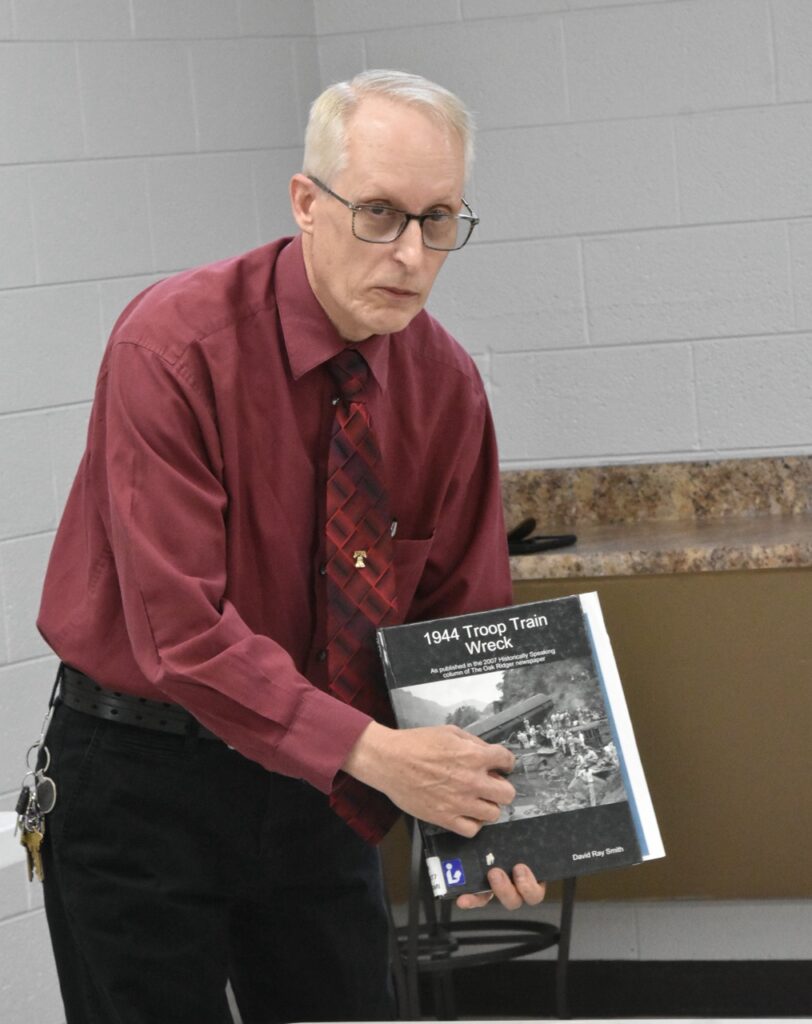
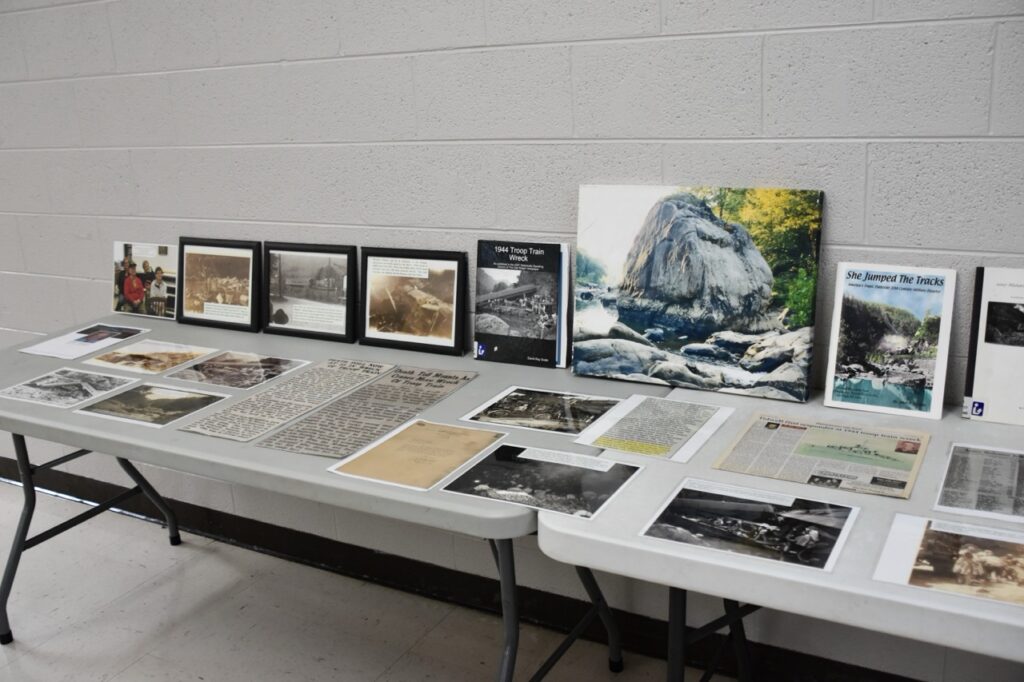
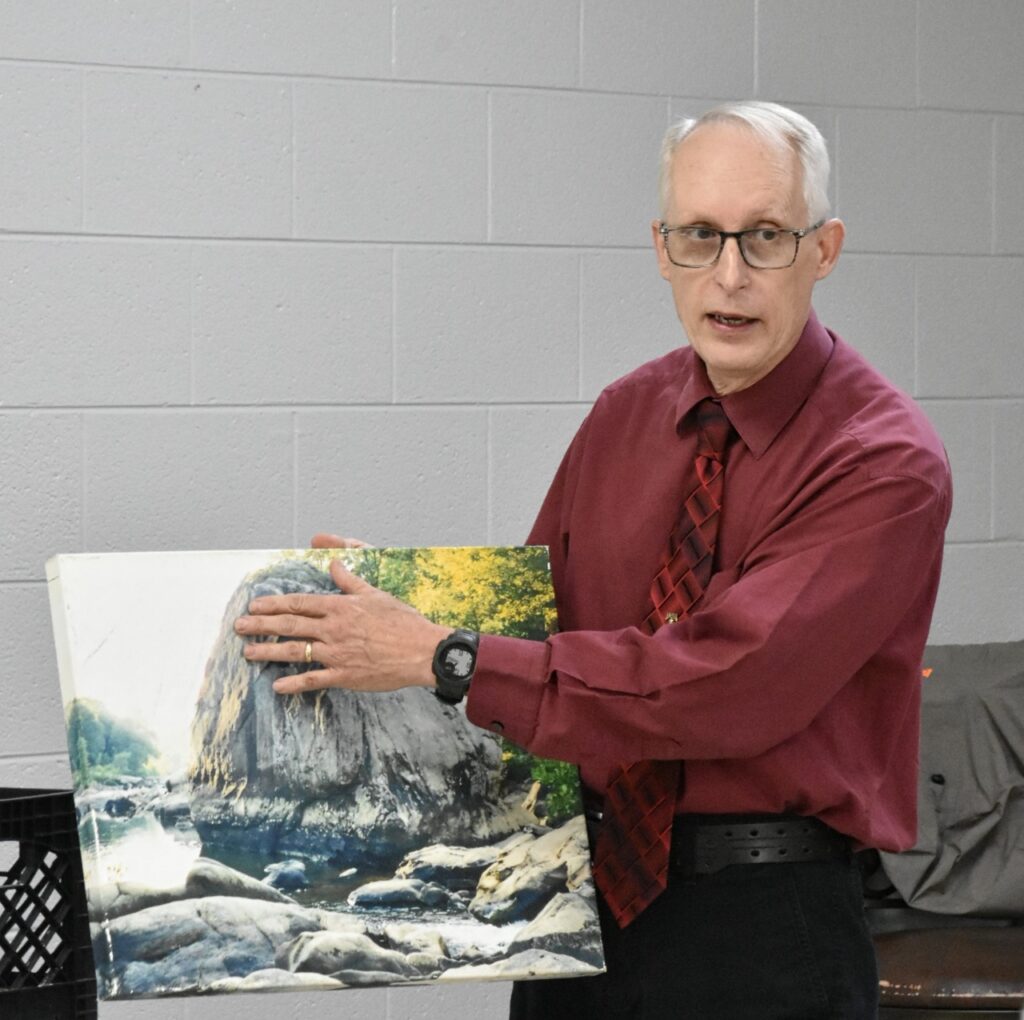
LAFOLLETTE, TN (WLAF)- Mark Tidwell, Jellico Librarian, grew up at Highcliff and learned about the 1944 Troop Train wreck first hand from his father, Jim. On Monday afternoon, Tidwell shared the accounts of the World War II state-side tragedy with members of the Lions Club at the former West La Follette School.
The wreck happened during World War II, very close to where Tidwell grew up and now lives.
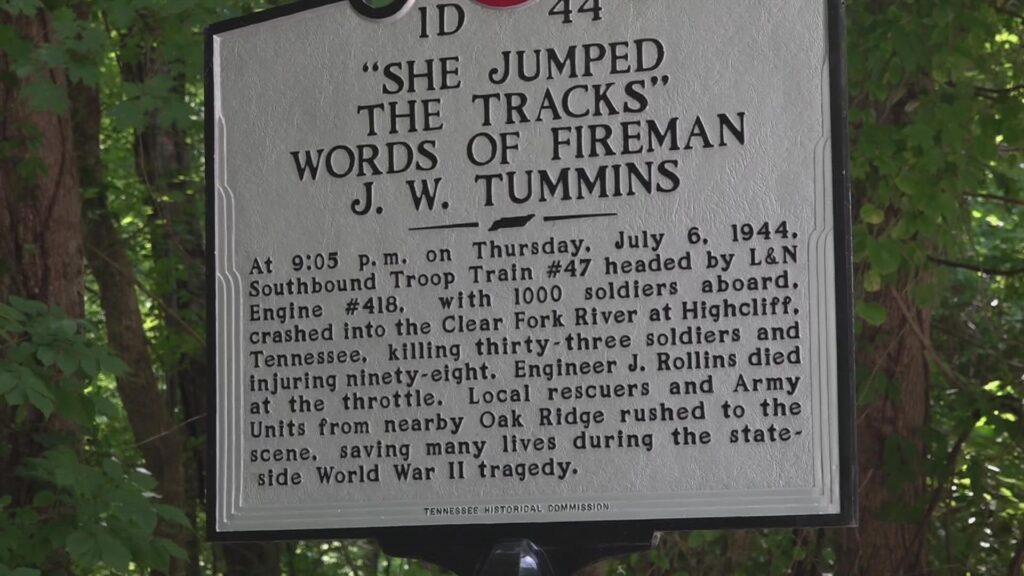
The Troop Train accident occurred at Highcliff, Tennessee, on July 6, 1944, at 9:05pm, when Troop Train #47, a southbound second-class passenger train derailed just past Highcliff. In total, 34 soldiers were killed, the crew of the Louisville and Nashville Railroad ‘s #418 (L & N), and engineer and a fireman were killed and more than 100 others injured. The troop train had a thousand soldiers aboard.
“She jumped the tracks” were the words of Fireman J.W. Tummins who was killed in the crash. These words are immortalized on the historical marker along Highway 25W, three miles south of Jellico. For safety purposes, so travelers have a place to pull off Highway 25W, the marker was placed about 900-feet north of where the train wreck occurred.
“It was at the height of World War II when 16 million men and women were in the service of the United States, and everything was geared towards the war effort. This train left Fort Benjamin Harrison in Indiana, heading for Camp Croft in South Carolina and it was hurry up for Uncle Sam and get there, so the train was kind of in the grasp of fate, the overall arching thing of World War II and it wrecked there at Highcliff and sadly killed 34 soldiers in the train crash,” Tidwell said.
After the train wrecked, there was a huge local rescue effort, mainly all local, with everyone coming together to help the soldiers, according to Tidwell. Ambulances, which were often hearses back then, came from all over to help with these rescue efforts. Funeral homes in Tennessee and Kentucky sent their ambulances to help.
Tidwell’s father, Jim, waved at the train as it passed by his Highcliff home that fateful night. The 16-year old soon heard the sound of the wreck and went to the scene and was there for the next three days. Tidwell later told his son that he wanted to do his part to help. He joined the U-S Navy the next year.
Army units from nearby Oak Ridge rushed to the scene as well, helping the local rescuers save as many lives as possible.
“It also sort of exposed Oak Ridge, because a lot of people didn’t know anything about Oak Ridge and what was happening there for the war effort, so when a military police unit showed up from Oak Ridge in Highcliff, and they started transporting the wounded and those that were injured to Oak Ridge, that was an eye opener for people,” Tidwell said.
The train consisted of the engine, tender, and 16 cars, with just a little more than 1,000 passengers on board, according to the final report.
The train passed Williamsburg, Kentucky, at 8:42pm, 13.11 miles north of Highcliff, running eight hours and two minutes late, passed Highcliff signal 202.3, and while it was moving at an estimated speed of 45 miles per hour, the engine and first eight cars derailed. Tidwell explained that officials considered 35 MPH the proper speed for a train to round that bend. It was also noted that the locomotive crew was manning a locomotive with an inoperable speed indicator.
Tidwell stated that it had been a very hot day that day. With the heat, the rails naturally expand, and it made the rails a little wider than usual, he added.
The state-side World War II Tragedy left its mark on the area and the names of the soldiers killed on Troop Train #47 are listed on Jellico’s downtown Veteran’s Monument. Soldiers came from five states, including Kentucky, Ohio, Indiana, West Virginia and Missouri.
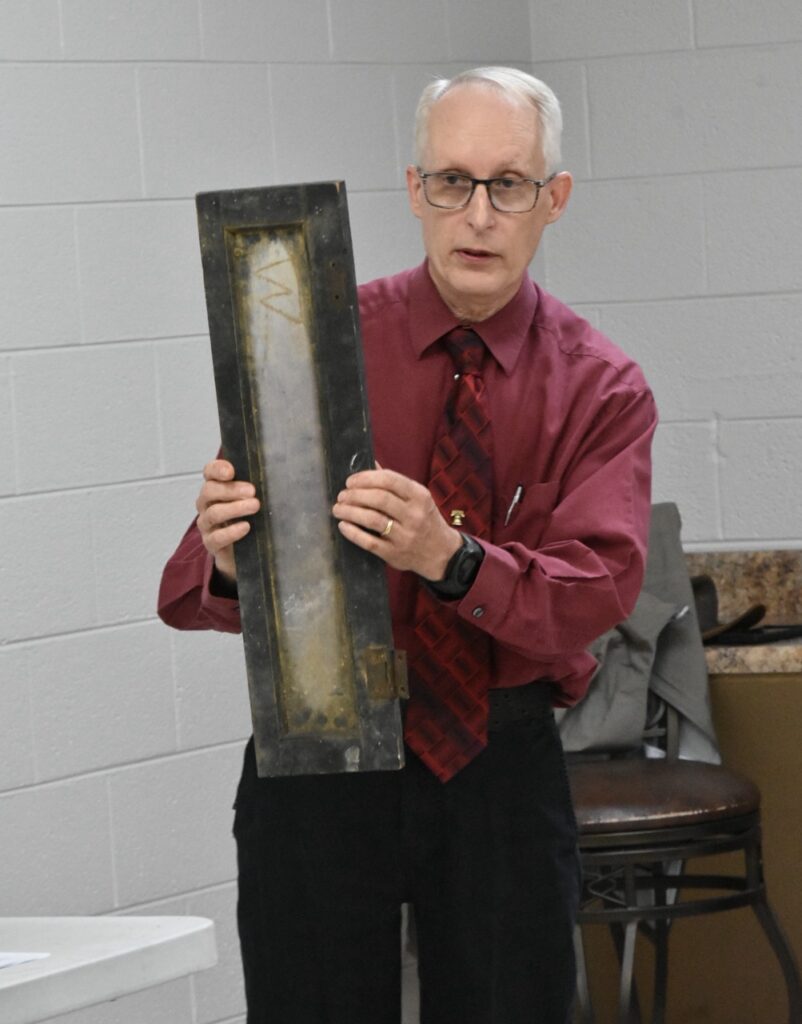
Tidwell also showed Lions the actual wing window from the locomotive as a special historical treat on Monday. Tidwell explained that this was the window the engineer, Lyle Rollins would look out.
The family of Everett Rollins donated the window to the Jellico library in 2021. Everett, the brother of the train engineer, took the window on the night of the wreck and passed it down to his family, who eventually after hearing of the history of the train wreck, gifted it to the museum.
The FBI investigated the wreck. “They responded to rumors of sabotage, but it was never proven,” said Tidwell.
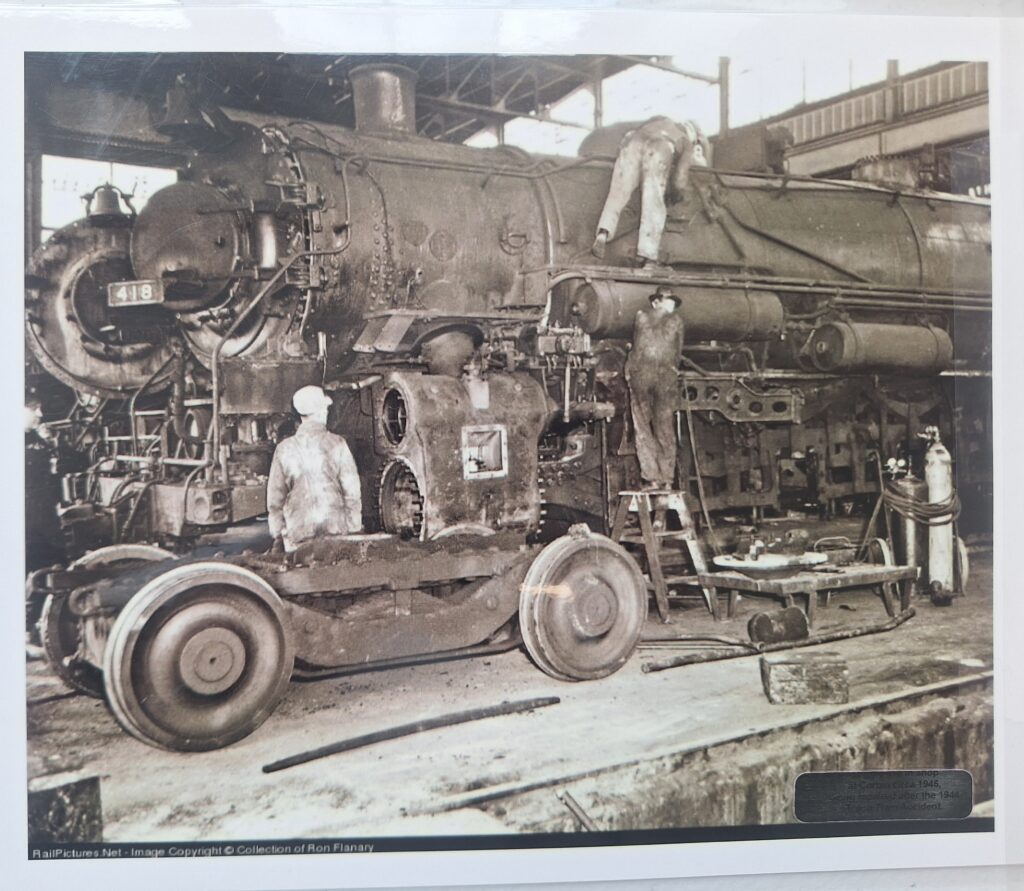
The scene of the wreck was cleared after about three to four days and the rail line opened very quickly afterward, according to Tidwell. The wrecked engine was pulled from Clear Fork River, which was running low at the time, by cranes and sent to the Corbin train yard for repair.
“The engine was repaired and put back in service. It was used to pull freight trains into the 1950s,” said Tidwell. (WLAF NEWS PUBLISHED-03/24/2026-6AM-PHOTOS COURTESY OF MARK TIDWELL, WLAF’S CHARLIE HUTSON AND WLAF’S CHARLOTTE UNDERWOOD)
PUBLISHER’S NOTE: WLAF’s Charlotte Underwood contributed to this story.
Here are a few quick factoids by Mark J. Tidwell, Jellico Library Director:
Troop Train Wreck at Highcliff, TN, Thursday evening, July 6th, 1944, 9:05pm
- One month after D-Day, which occurred on June 6th, 1944, Uncle Sam was needing every available GI to the front as soon as possible!
- A little over 1,000 soldiers boarded L&N Troop Train #47 at Fort Benjamin Harrison near Indianapolis, Indiana, bound for Camp Croft South, Carolina, an Infantry Replacement Center near Spartanburg, SC. From there, these Gis were ultimately headed overseas to units sorely in need of “fresh” soldiers.
- The railroad’s job was to get these soldiers from point A to B without delay!
- Engine 418 roared through Highcliff, TN that Thursday evening, belching smoke and steam, leaving Kentucky on a long straight-of-way, before entering the curvy “Tennessee Rockies” in the Clear Fork River Gorge.
- In a steep curve, the engine “Jumped The Tracks” and pulled several cars of the 16-unit train into the Clear Fork River. Fire broke out. Pandemonium followed.
- 34 soldiers (from 5 states) and the engineer (Lyle Rollins) and fireman (John Tummins) were killed. Over 100 soldiers were seriously injured.
- Causation of wreck: multiple factors. Hot day, expansion of rails to a wider than standard gauge. Speed too high. 35 mph curve, train estimated doing 45. The speedometer in the locomotive was inoperable at the time of the wreck. This series of locomotive, was later found to have front trucks that did not slew properly in steep curves. The overarching events of “Hurry Up!” during WW2, crew fatigue and mechanical influencers held the souls of this train crew in their firm grip.
- During the first 18 or so years of my work career at Jellico Library, I regularly hosted soldiers, and or families of those with Troop Train ties, returning to Jellico to see where they were injured, a buddy had been killed, or a family wanted to see where a loved one was killed on the train. “They’ve stopped coming now” as anyone on the train would be 100 or so years old, but mostly they’ve passed on. I was fortunate to cross paths with so many first-hand experiencers of that era of history.
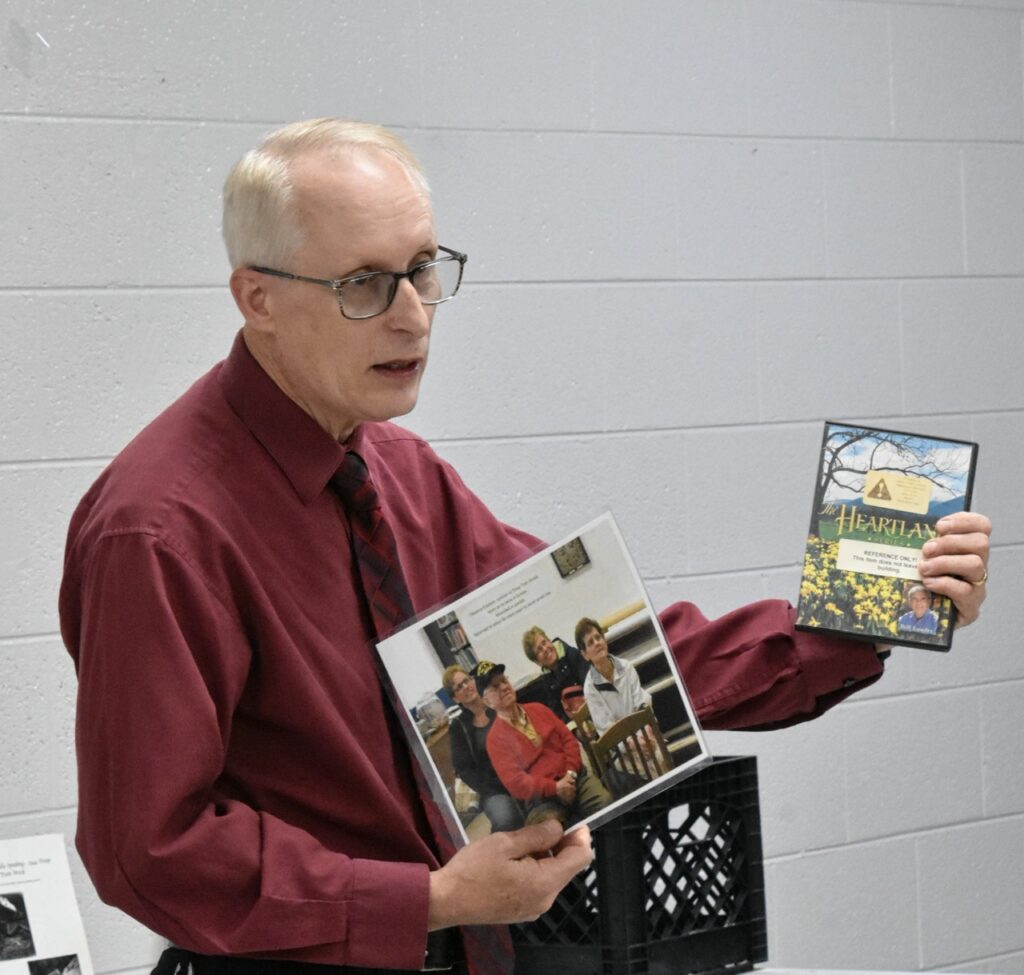
- My late father, James Tidwell Jr., was 16 years old when the train passed through Highcliff, where he was raised, and I still live. When he heard the crash, he sprinted up the tracks and was most likely the first responder on scene. He tells his story on “The Heartland Series” by WBIR, Volume 16, Episode 15, “Troop Train #47”.
- If any of the Greatest Generation can be termed “typical”, Mr. Clarence Eckstein, Celina, Ohio, was a typical survivor of the Troop Train Accident. He returned to Jellico for many years, until he passed in 2018. He was injured in the wreck, went on to serve in Europe where he was seriously wounded, received 3 Bronze Stars, retuned home and worked for the Postal Service for 30 years, was a charter member of Celina VFW Post 5713, a life member of the 11th Armored Division, and was a van driver for the Celina Council on Aging. He had 6 daughters, 3 sons, 25 grandchildren, and 65 great grandchildren, and left behind his wife Alberta of 60 years. Yet with such a life of accomplishment and fulfillment, he still took time out to return, again and again, to see the place that had such a profound effect on his life, the site of the Troop Train Accident of July 6th, 1944, a final destination for many of those he rode with that evening on the way to places of death and war, across great oceans. Little did anyone on the train anticipate that such death, suffering and destruction awaited them in Highcliff, Tennessee, on that Thursday evening, 82 years ago.
Very interesting story, thank you for sharing.
My Dad has told me stories about this. He grew up in Habersham, TN. He would have been 5yrs old at the time.