.jpg)
 Wlaf1450
‘Number one cause a teen experiments with drugs is in medicine cabinets; locking up meds is key’- Kristi Beeler
By Charlotte Underwood
JACKSBORO, TN (WLAF)- Campbell United, Campbell County’s anti-drug coalition, met at TCAT on Thursday at noon for its February meeting, with members receiving overdose training and learning how to administer Naloxone, also known as Narcan, in the case of an overdose.
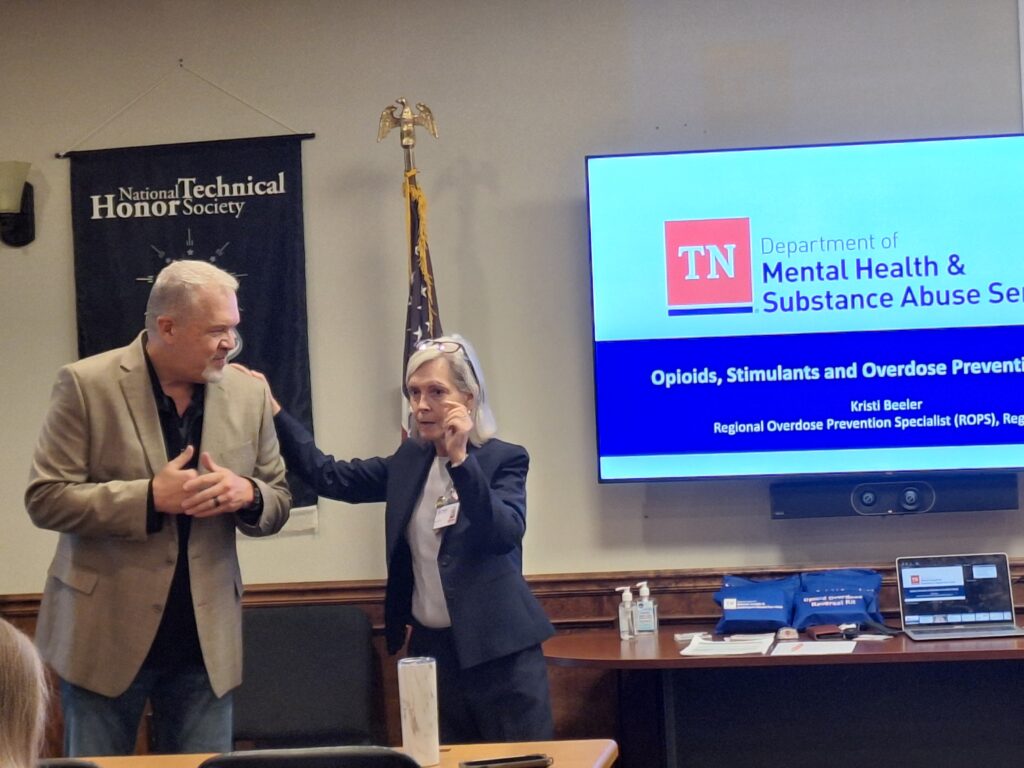
Kristi Beeler, Regional Overdose Prevention Specialist with the TN Department of Mental Health and Substance Abuse Services, led the training session.
According to Beeler, she is one of about 25 overdose prevention specialists “scattered across the state.”
“We are unashamedly trying to keep people alive,” Beeler said.
Tennessee was one of the “hardest hit states in the nation”, coming in at number two on overdose fatalities, second only to West Virginia.
“We were hired in response to all the opioid overdoses in the state of Tennessee and really the nation has seen. So, we were hired to reduce and prevent as many overdoses as we could through distribution of Naloxone, but also through partnering with agencies first responders, community resource agencies and high-risk individuals and family members,” Beeler said.
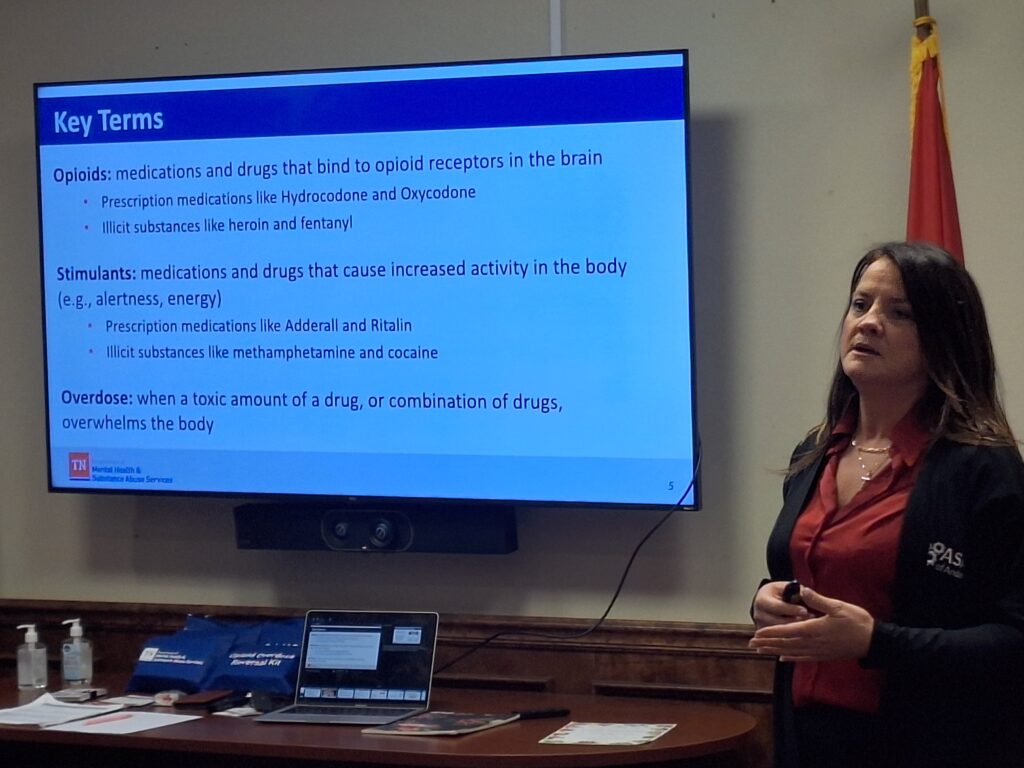
The training agenda was lengthy and included an introduction to key terms, the review of overdose trends in Tennessee, as well as in the county and region. Beeler also discussed the “science of addiction”, as well as covered a section on “understanding stigma related to drug addiction.” Other agenda items in the training included how to recognize the signs and symptoms of opioid and stimulant overdoses and how to respond to an overdose with Naloxone. Finally, she touched on “understanding compassion fatigue and burnout” before finishing up with how others could take action to prevent overdoses in your own community.
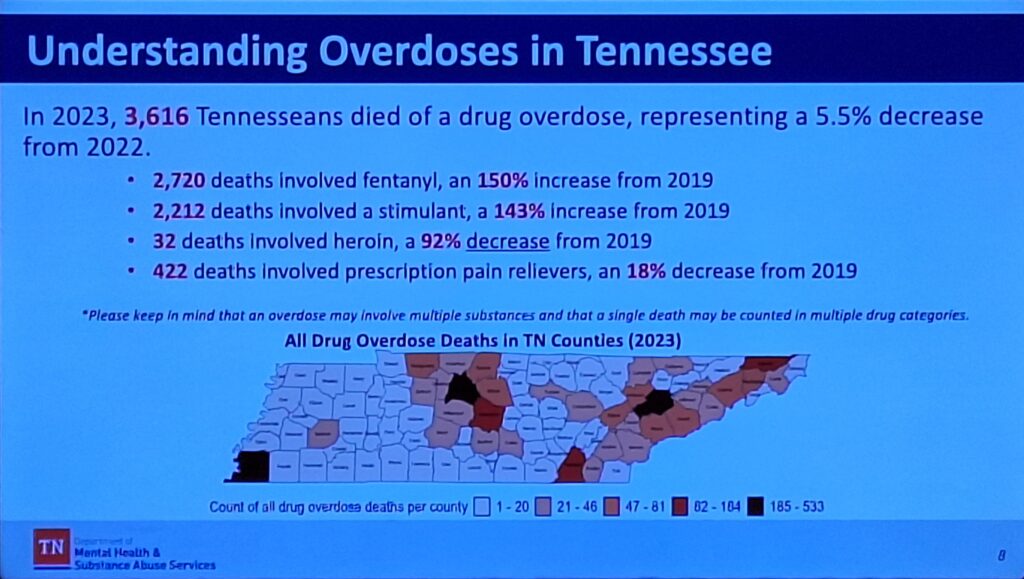
While she spoke on understanding the opioid epidemic, Beeler shared that in Tennessee, like many other states, the trend “shows a shift in the primary cause of the overdose epidemic from prescription pain relievers to illicit substances.”
In 2023, 3,616 Tennesseans died of a drug overdose, representing a 5.5 decrease from 2022. These statistics were broken down further to reveal that 2,720 of those deaths involved Fentanyl, a 150% increase from 2019 statistics. Also, in those 2023 statistics it showed that 2,212 deaths involved a stimulant which showed a 143% increase from 2019 statistics. Heroin deaths showed a 92% decrease from 2019 statistics, with 32 heroin related overdose deaths recorded in 2023. There were 422 deaths from prescription pain killers, which showed an 18% decrease from 2019 statistics. A lot of overdoses involve multiple substances, with 2023 showing multiple overdoses involving both Fentanyl and a stimulant.
“If you guys respond to an overdose, I want you to just assume that Fentanyl is involved,” Beeler said.
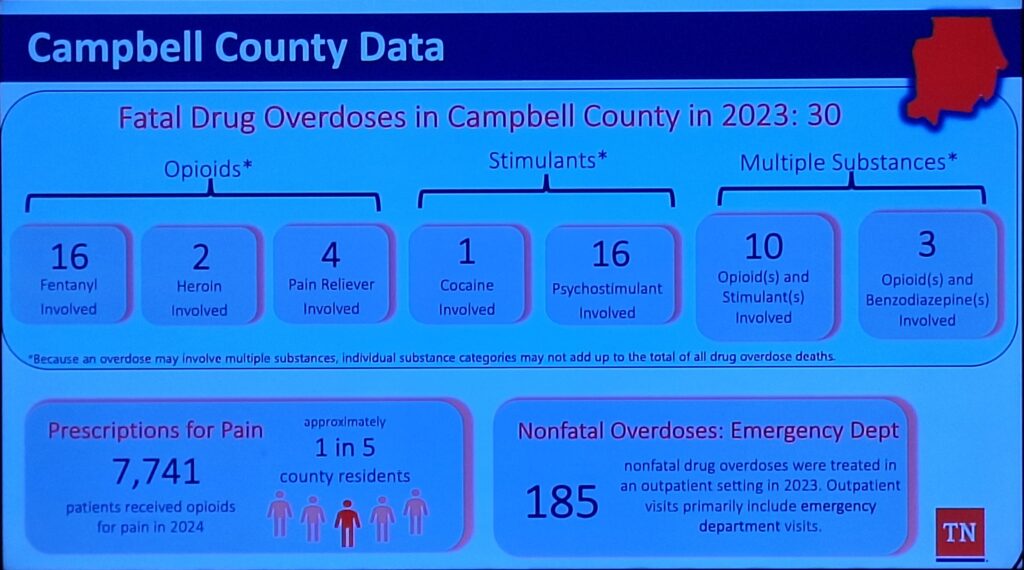
She also covered Campbell County specific data.
“What we have reported through the department of health is 30 fatal overdoses; 16 involved Fentanyl, two had heroin, four had pain relievers, one had cocaine. Sixteen had psychostimulants and that is primarily meth, 10 had opioid and stimulant, primarily meth and Fentanyl and three had opioids and Benzodiazepine involved,” Beeler said.
She said “non-fatal overdoses” is data that she also pays attention to and that for 2023, Campbell County showed 185 non-fatal.
“That number is very underreported, the only way that number is reported at that state level is when the individual that has overdosed and is seen by first responders, agrees to get in the car and go for a ride and get help, my first responders across the region tell me that 70 to 80% of those overdosing sign the medical waiver after the Narcan and stay home for different reasons … so for every one that goes in, there is about nine that stay home, so times that 185 by nine and you have the actual overdose number for the county,” Beeler said.
Other things that the TN Mental Health & Substance Abuse Services provide is a “Lived experience” to leverage real-world experience to provide authentic insight and understanding.
A big part of the program that Beeler is part of includes “peer recovery specialists” who share their story with those in the state of addiction and show them there is hope to get better.
“We see a lot of individuals find recovery through that peer support and the state has started hiring more positions for that to beef that up,” Beeler said.
Overdose prevention strategies is multi-faceted and includes understanding that behavior change is an “incremental process.”
She went over how important it is to reduce stigma and have a “non-judgmental approach with a focus on enhancing quality of life.”
The ultimate goal is to “empower those who use substances to be the primary agents in reducing the harms of their substance use.”
The state program also provides “Care Coordination continuously for up to 12 months to “ensure long term success and support.”
The state saw a 31.6% decrease of overdoses from the prior year, surpassing the nation with theirs at 25%.
“We have a lot of people doing a lot of work, our coalitions, our TN recovery navigators are in the hospitals now, there’s a lot of care coordinator positions, we just partnered with Ridgeview in Oak Ridge, so, its meeting people at the highest point of desperation and giving them a life-saver, giving them a life vest so they can come out of it,” Beeler said.
She described the importance of reaching the youth.
“What makes a difference if a student is thriving and one is not almost always, is something called the protective factor and it was usually like an adult that was pouring into them, it was a coach, a teacher, a pastor, somebody that was teaching them they could dream outside the walls that they were living in, because you also have generational cycles addiction, you’ve also got kiddos growing up in environments where that’s their norm, that is there norm,” Beeler said.
She said, “teaching kids to dream outside their walls” and that “there is more than what they are seeing in front of them” is the key.
“It often starts again, by one adult, so the part that you play in your communities is a huge role as a protective factor, you may not think of it that way, but it is,” Beeler said.
Beeler taught Campbell United members how to administer Naloxone in the event of an overdose and also handed out overdose response kits to those who wanted them.
“Naloxone is readily available through our program, through pharmacies across the state and other community agencies; currently we’ve been a part of reversing over 83,000 overdose deaths in the state since 2017,” Beeler said.
She told members they were part of the solution.
“What you can do in your community – stay connected to Campbell United, this is such a great community organization to go upstream and to figure out some ways to curb addiction from ever happening, so I encourage you to keep advocating,” Beeler said.
She said everyone in the community can help by “locking up prescription medications and that the number one cause that a teenager will experiment is in the medicine cabinet.”
“It creates a barrier and that reduces the chance of them getting into it.” She also encourages others to drop off unused mediations.
Campbell United hosts “drug take back” days in the county each year, and the county has two permanent medication disposal containers for the public to use, one at the Campbell County Sheriff’s Office and another at the Jellico Police Department.
The next Campbell United meeting is scheduled for Thursday, March 12, noon, at TCAT Jacksboro at 265 Elkins Road. Organizers encourage community leaders, nonprofits, organizations, and others to join! (WLAF NEWS PUBLISHED-02/17/2026-6AM)